Reducing Quality and Food Losses Through Smart Innovations
Worldwide, significant challenges remain in the storage and logistics of potatoes and grains. Heat, moisture and inadequate ventilation can lead to spoilage, mould formation and pest infestations, resulting in substantial quality degradation and food losses. In North-West Europe, where these crops form a vital part of the food supply chain, the associated financial losses amount to millions of euros each year. Port of Zwolle is currently facilitating two innovative pilot projects to address this issue. We spoke with project manager Lennard Drogendijk.
Port of Zwolle is the logistical gateway to the Zwolle Region: a physical hub where inland waterways, rail and road networks converge. From the ports of Zwolle, Meppel and Kampen, Port of Zwolle provides multimodal connections and serves as a key hub for the European hinterland. Its activities focus on connecting businesses, government and educational institutions, with a strong emphasis on sustainability, circular economy initiatives and the energy transition. In this way, Port of Zwolle is developing into a future-proof regional hub where collaboration and innovation go hand in hand.
Port of Zwolle also acts as a facilitator, supporting logistics companies in the development and adoption of innovations. In this context, Port of Zwolle is the lead partner in the international DODILog project (Develop Opportunities to Digitalise & Innovate in the Agri-Food Value Chain’s Logistics), which is partly funded by the EU’s Interreg North-West Europe Programme.
Over the next three years, partners from the Netherlands, Belgium, France and Germany will work together to identify and implement smart and sustainable innovations for the storage and logistics of potatoes and grains.
How does this collaboration take shape in practice? What is being tested and developed?
“Specifically, the pilots involve Tapp from Leeuwarden and Javelot from France. Tapp provides paper-based sensors that monitor, among other things, temperature. These paper sensors are placed at various locations within a container or big bag. When they are retrieved after a certain period, they provide insight into temperature and humidity conditions throughout the transport process. If temperature or humidity levels have exceeded safe thresholds at any point, corrective measures can be taken to prevent grain or potatoes from spoiling or
contaminating other products. This also helps to avoid potential damage claims, which can result in significant cost savings. A major advantage of Tapp’s data loggers is that, after use, they can simply be disposed of with waste paper, making them a highly sustainable solution.”
And what about the French company? How is that pilot progressing?
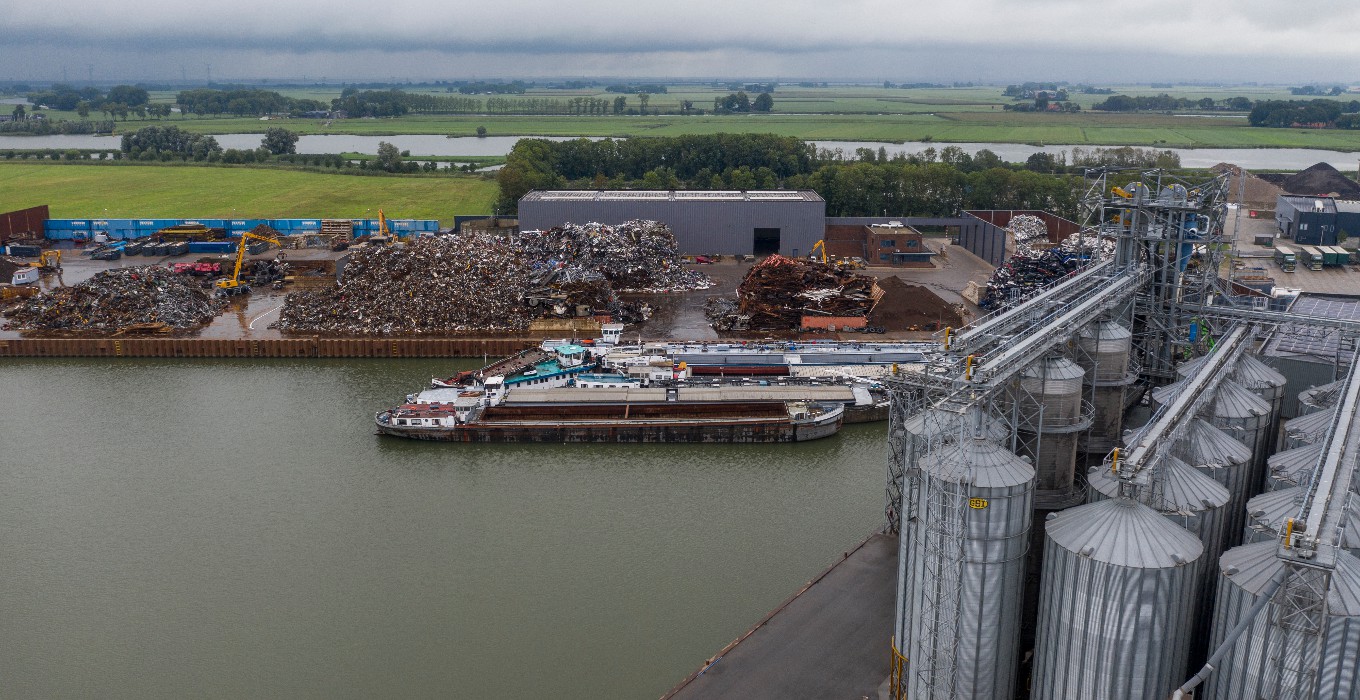
“Javelot has developed an innovative temperature measurement and ventilation control system, complemented by a probe of up to 10 metres in length for flat storage or as a suspension cable for vertical silos. Similar to the Dutch solution, these rod-based sensors continuously measure temperature and help prevent the formation of insect colonies, a common issue in large-scale food storage. In this pilot, three silos at Graansloot Kampen are being used: one operating in a traditional manner, one equipped with the Javelot application, and one with the Javelot Plus application, in which Javelot also controls ventilation based on outside air humidity. We will be working on this together in the coming months. We expect to be able to present results and
recommendations related to the Tapp solution by the end of the year or shortly thereafter. The Javelot solution is expected to deliver its first results around the summer of 2026.”
Can you tell us more about DODILog?
“DODILog develops, tests and implements innovative solutions aimed at extending the shelf life of crops and reducing losses. The project includes a range of practical trials in silos, warehouses and containers. These involve, among other things, early insect detection using Near Infrared Spectroscopy (NIRS); real-time quality monitoring through the application of sub-THz sensors and multi-gas eNose technology; the measurement of temperature and humidity using smart sensors and chips; and the optimisation of ventilation and storage conditions through AI-driven control systems.”
Does DODILog also focus on knowledge transfer?
“Absolutely. DODILog also invests in training, knowledge sharing and strategy development to ensure that these innovations can be widely applied across the European agri-food sector. DODILog is a transnational initiative involving eleven partners from the Netherlands, Belgium, France and Germany. Port of Zwolle acts as lead partner and coordinates the project. Together with partners such as Graansloot Kampen, technologies are tested in real-life operational settings. In addition, Port of Zwolle organises webinars, workshops and knowledge exchange activities to further disseminate the innovations.” The first workshops will take place later this year.
This is a time-bound project. What is its duration?
“DODILog runs from 1 January 2025 to 31 December 2027 and has a total budget of €5.5 million, of which approximately 60% is co-financed by the European Union. The project aims to deliver seven innovative applications, three joint training programmes with a total of sixty participants, and one overarching strategy for innovation in European agri-food logistics.”
The eleven DODILog partners are Port of Zwolle and Graansloot Kampen B.V. from the Netherlands; VIVES University of Applied Sciences, Inagro and Multitel from Belgium; Circoé, Arvalis, Bretagne Développement Innovation (BDI) and Javelot from France; and Polytec and Wirtschaftsverband Weser from Germany.
How can companies get involved or stay informed about developments?
“Companies can stay up to date by following the Port of Zwolle website and social media channels. These platforms will be used to announce workshops and share news about the innovations and project developments.”
Date:
January 5, 2026
Autor:
Brandstory Nieuwsblad Transport (translated by AI)
Photographer:
Share with: