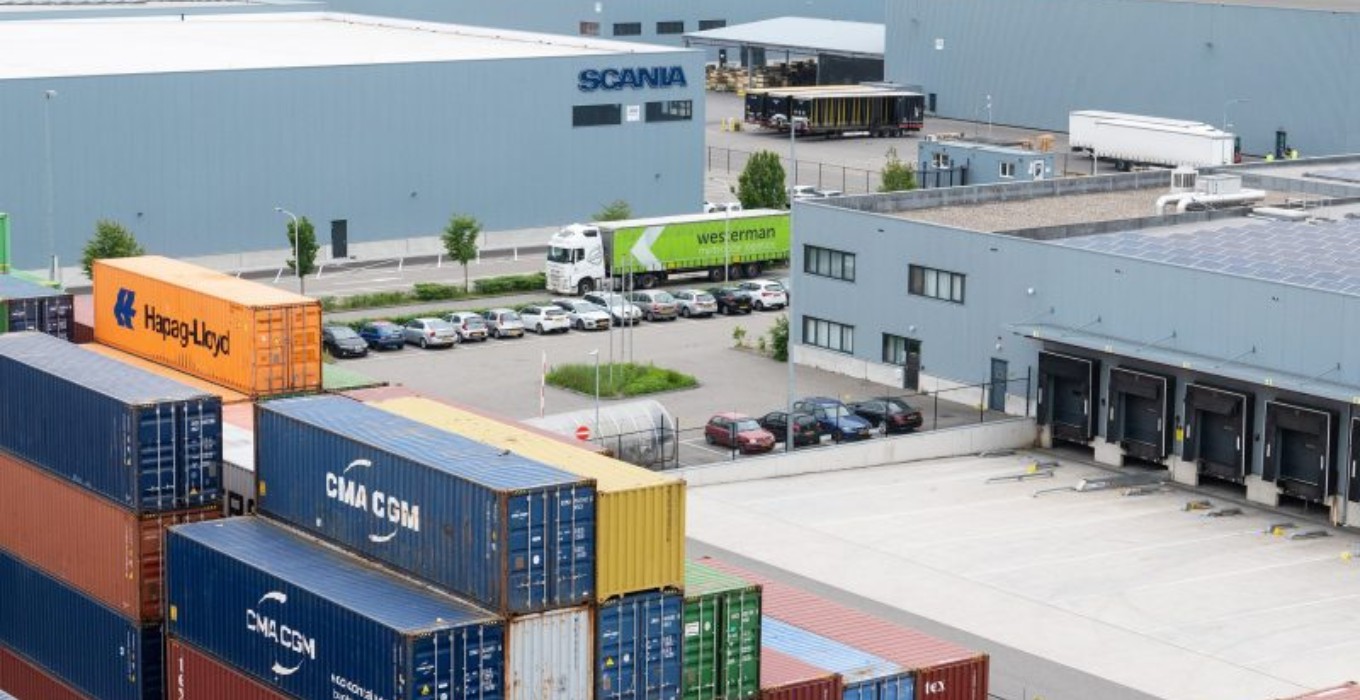
Scania Logistics coordinates global network from Zwolle
Every day, parts from suppliers around the world arrive in Zwolle. Complete trucks, chassis, spare parts and truck kits are shipped from Zwolle to manufacturing sites across Europe, South America and China, as well as to markets such as South Africa, Indonesia and Malaysia. Behind these flows of goods is a logistics organisation that continuously aligns suppliers, inventories and production planning on a global scale.
Over the past years, Scania Logistics in Zwolle has developed into a key hub within Scania’s international network. Every day, the organisation coordinates approximately 700 to 800 trucks throughout Europe. In addition, Scania Logistics oversees around 1,200 suppliers and approximately 12,000 active parts.
“We manage the entire supply chain planning process, from suppliers to production facilities around the world,” says Managing Director René Brill.
According to Brill, the role of logistics has changed significantly in recent years. The organisation is no longer focused solely on transport and inventory management. Production planning, capacity coordination and supplier management are now also integrated into the operation in Zwolle.
“We ensure that materials remain available, production facilities can continue operating, and goods flows are aligned,” he says. “At the same time, we continuously synchronise supply chains, production and sales.”
This is done on a global scale. From Zwolle, Scania Logistics organises not only European goods movements, but also import flows from Asia and distribution to other continents. The organisation also manages KD (Knock-Down) shipments: complete trucks that are shipped in component form to other countries for local assembly.
A Logistics Puzzle
According to Scania Logistics, this scale makes sustainability a daily logistical challenge. Every transport movement, container and modal choice affects the total carbon footprint of the network.
Scania has been running a programme for many years aimed at reducing logistics-related carbon emissions. Since 2016, the carbon footprint within its logistics network has been reduced by approximately 42 percent. Part of the freight is transported by rail or inland shipping, carriers increasingly operate on alternative fuels, and trailers are loaded as efficiently as possible.
“With large suppliers, direct transportation works well,” says Brill. “For smaller volumes, we consolidate goods flows.”
Electrification is also playing an increasingly important role within the logistics operation. According to Brill, the focus is gradually shifting from regional distribution towards international long-distance transport.
“The products are available,” he says. “The biggest challenge now lies primarily in the infrastructure.”
Switching Globally
The importance of flexibility in supply chains became evident during the floods in Brazil last year. Several suppliers were temporarily unable to deliver, while production had to continue. In response, Scania Logistics in Zwolle began redirecting goods flows between continents. European suppliers took over part of the supply requirements.
“Because of our global organisation, we were able to respond quickly,” says Brill.
He believes that international integration will continue to increase in the coming years. Within the TRATON Group, which includes Scania and several other truck brands, more shared logistics structures are being developed.
“This also creates more opportunities to shift goods flows between continents,” he says.
Changing Skills and Employment
The ongoing changes affect not only goods flows but also the nature of logistics work itself. Automation and digitalisation are transforming logistics operations at a rapid pace, while new warehouses are taking over an increasing number of physical activities. As a result, workforce requirements are changing as well.
“You see more system engineering and less purely physical flow engineering,” says Brill.
According to him, the Zwolle region continues to benefit from a strong logistics and technical knowledge base. Collaboration with universities of applied sciences and research universities in Zwolle, Twente and Groningen plays an important role in maintaining that strength.
At the same time, Scania Logistics also experiences labour market shortages.
“It is more difficult than it used to be to find people,” says Brill. “That is why continuous investment in knowledge, development and innovation remains essential.”
Zwolle’s Strength as a Logistics Region
In addition to his role at Scania, Brill serves as Chairman of Logistics Overijssel, a partnership between government, education and industry.
According to him, Overijssel sometimes underestimates its own position as a logistics region. Zwolle is located close to major freight corridors, combines multiple transport modes and benefits from its strategic connection to Port of Zwolle.
“In the Netherlands, everything is effectively located within a very small area,” says Brill.
Date:
July 5, 2026
Autor:
Johan Koning for Port of Zwolle (Brand story Nieuwsblad Transport)
Photographer:
Scania Logistics
Share with: